
Field Guides & Technical Workflows
Mastering the craft of fine-art photography requires bridging raw field acquisition with deliberate digital darkroom execution.
These educational guides establish comprehensive, repeatable systems for capturing the natural world and the cosmos with uncompromising detail, clarity, and precision. Developed from rigorous field testing and technical post-processing workflows, each standard operating procedure is designed to elevate your craft—transforming complex camera mechanics, optical planning, and advanced digital processing into gallery-grade master files.
Explore the published field guides and processing manuals below, with new technical workflows, capture strategies, and post-production modules added regularly.
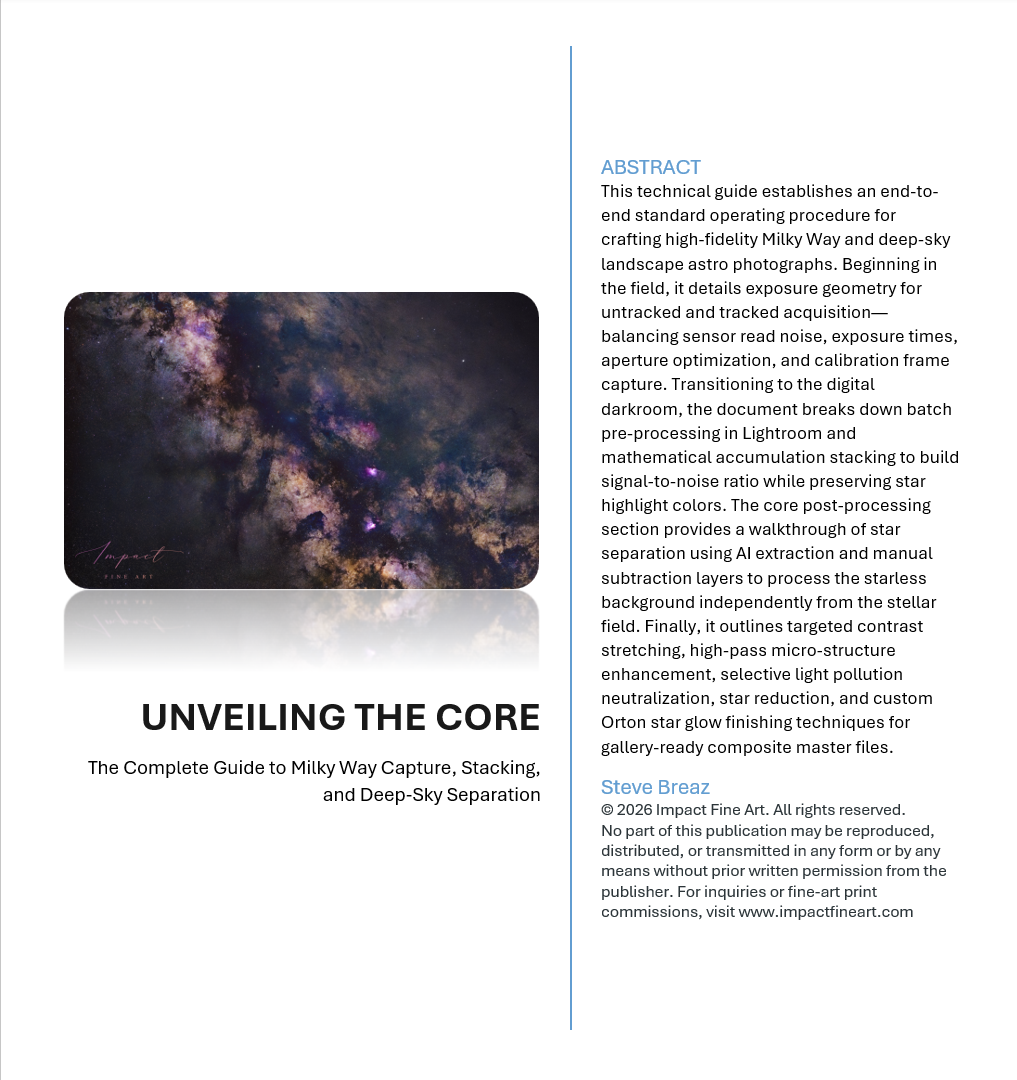
Elevate your astrophotography from standard single exposures to pristine, gallery-grade fine-art prints. Unveiling the Core is an end-to-end standard operating procedure that bridges precision field acquisition with advanced, artifact-free digital darkroom workflows.
Learn the exact mathematical and creative workflows required to separate dense stellar fields from deep-space nebulosity, unlocking unprecedented dynamic range, rich dust lane structures, and natural star colors without bloat or distortion.
What’s Inside the Workflow
Field Acquisition & Exposure Geometry: Master both untracked and equatorial-tracked capture strategies. Calculate exposure limits, optimize sensor read noise, dial in aperture sweet spots, and shoot critical calibration frames (darks, flats, and bias).
Pre-Processing & Mathematical Stacking: Batch calibrate raw data in Lightroom and execute accumulation stacking in dedicated software to maximize Signal-to-Noise Ratio (SNR) while protecting pinpoint star core highlights from clipping.
AI & Mathematical Star Separation: Step-by-step walkthroughs using AI extraction and manual subtraction layers to decouple the stellar field from background nebulosity—allowing independent manipulation of dust lanes without star interference.
Advanced Galactic Core Sculpting: Apply targeted contrast stretching, frequency-based denoising, high-pass micro-structure enhancement, and selective light pollution neutralization.
Fine-Art Finishing & Polish: Execute professional star reduction, micro-star threshold clipping, and subtle celestial Orton bloom effects for clean, museum-ready master files.
Product Specifications
Format: Instant Digital Download (Comprehensive PDF Standard Operating Procedure)
Software Covered: Adobe Lightroom Classic, Adobe Photoshop, Dedicated Stacking Engines (Sequator / Starry Landscape Stacker), and AI Separation Plugins
Skill Level: Intermediate to Advanced astrophotographers and landscape printmakers
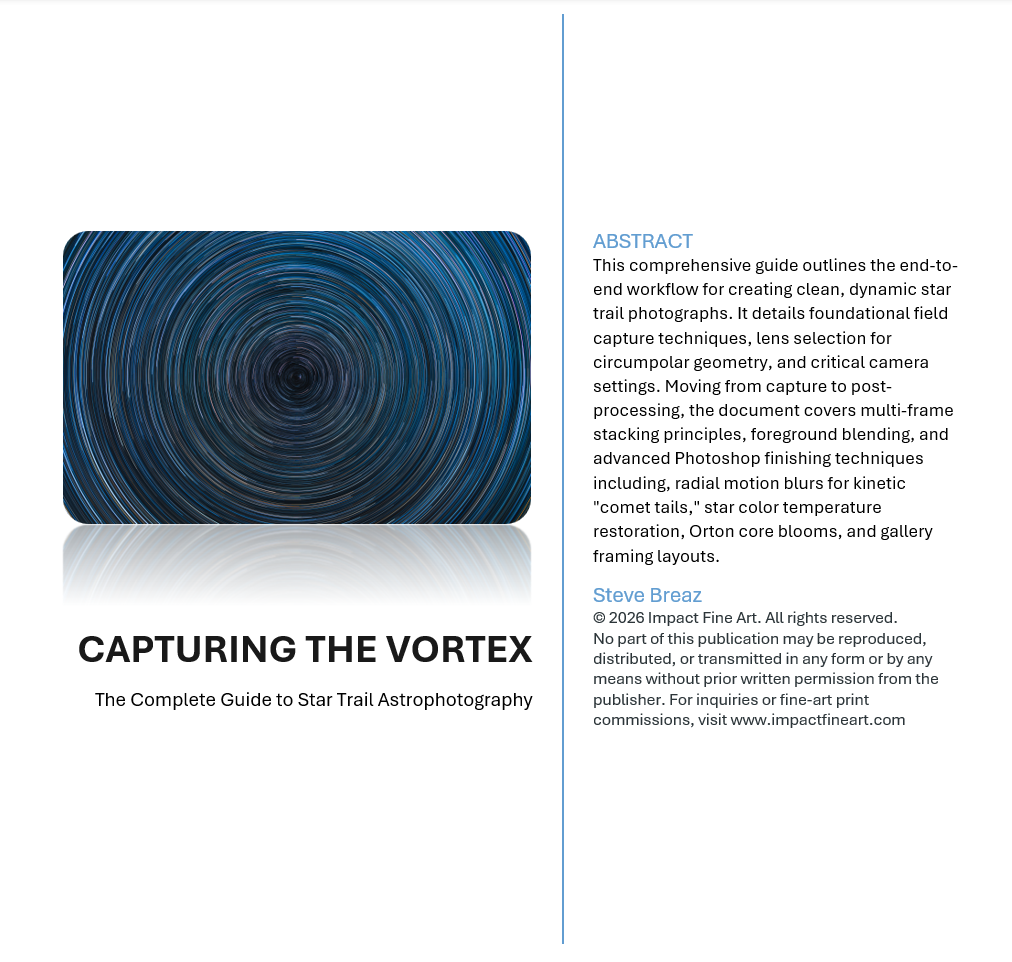
Transform static concentric rings into dynamic, gallery-grade fine-art astrophotography. Capturing the Vortex is an end-to-end standard operating procedure that bridges precision circumpolar field planning with advanced Photoshop motion-crafting workflows.
Learn the exact technical and creative systems required to execute seamless multi-hour data acquisitions, eliminate frame gaps, restore rich spectral star colors, and sculpt hypnotic, kinetic star trails ready for large-format exhibition.
What’s Inside the Workflow
Circumpolar Planning & Field Execution: Master lens selection for celestial pole geometry, polar alignment strategies, manual exposure baselines, intervalometer timing, and critical camera overrides to prevent broken trails.
Dedicated Foreground Anchoring: Capture pristine, noise-free terrestrial base plates during twilight or deep night to establish razor-sharp landscape foundations beneath the sky.
Multi-Frame Stacking Principles: Batch synchronize RAW data in Lightroom and execute multi-frame accumulation stacking in dedicated software without star bloat or digital artifacting.
Kinetic "Comet Tail" Sculpting: Step-by-step techniques using radial spin blurs and directional gradient masks to transform uniform rings into tapered, high-speed comet streaks while keeping the celestial pole needle-sharp.
Fine-Art Color & Gallery Finishing: Restore authentic stellar color temperatures (amber giants and blue dwarfs), execute subtle Orton core blooms around Polaris, and build weighted museum digital mattes with precision keyline framing.
Product Specifications
Format: Instant Digital Download (Comprehensive PDF Standard Operating Procedure)
Software Covered: Adobe Lightroom Classic, Adobe Photoshop, and Dedicated Stacking Engines (StarStaX / Sequator)
Skill Level: Beginner to Advanced nightscape photographers and fine-art printmakers
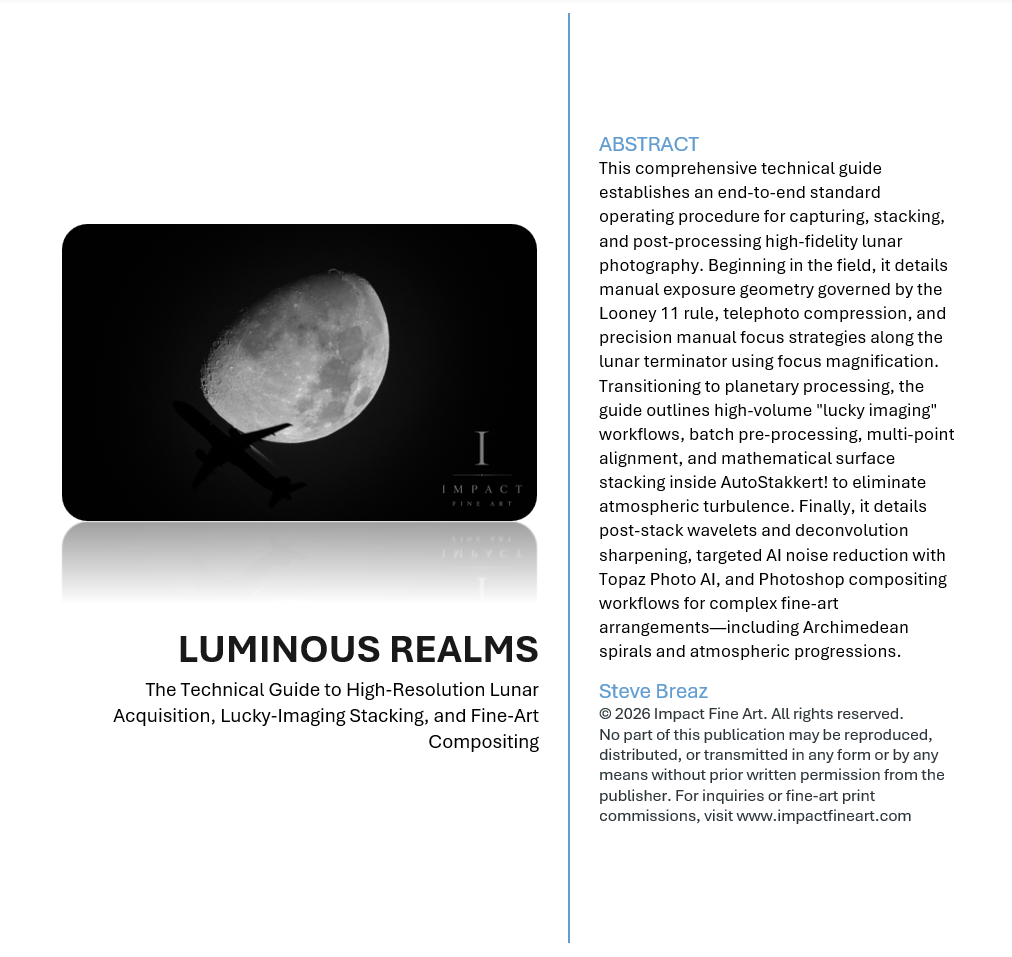
Transform standard telephoto moon shots into razor-sharp, gallery-grade lunar masterworks. Luminous Realms is a comprehensive standard operating procedure that bridges high-magnification field acquisition with advanced lucky-imaging reconstruction and multi-plate fine-art compositing.
Learn the exact mathematical and creative workflows required to overcome atmospheric turbulence, extract tactile surface micro-contrast along the terminator, and composite high-resolution lunar disks into museum-ready fine-art arrangements.
What’s Inside the Workflow
High-Magnification Field Acquisition: Master telephoto and super-telephoto exposure geometry using the Looney 11 principle. Dial in critical focus magnification on the lunar terminator and configure vibration-free shutter overrides.
Lucky Imaging & AutoStakkert! SOP: Execute planetary surface alignment and accumulation stacking to cut through atmospheric seeing, discard blurred frames, and build an exceptional Signal-to-Noise Ratio (SNR).
Frequency Deconvolution & AI Polish: Apply targeted wavelets, high-pass micro-structure pop, and controlled Topaz Photo AI refinement to enhance crater relief and maria textures without brittle halos or digital artifacts.
Fine-Art Composite Architectures: Step-by-step master layouts for large-format fine-art prints—including geometrically balanced Archimedean spirals and organic atmospheric smoke progressions.
Master File Archiving & Output: Prepare 16-bit master files and color spaces optimized for high-end acrylic face-mounts and museum cotton rag papers.
Product Specifications
Format: Instant Digital Download (Comprehensive PDF Standard Operating Procedure)
Software Covered: Adobe Lightroom Classic, AutoStakkert! (AS!3 / AS!4), Adobe Photoshop, and Topaz Photo AI
Skill Level: Intermediate to Advanced astrophotographers and fine-art printmakers
✺ Frequently asked questions ✺
-
No. If you can use manual mode (set shutter, aperture, ISO) you’re good. We cover planning, exposure, stacking, and blending step-by-step in the field and in the virtual labs.
-
Any modern mirrorless/DSLR that shoots RAW, a sturdy tripod, and a wide/fast lens (roughly 14–24mm at f/1.4–2.8). A mid-zoom (24–70mm) is great for blue hour; a 70–200mm is optional for layered valley shots.
-
Short and mostly flat: plan on 0.5–1.5 miles total per evening from paved pullouts/boardwalks with occasional steps/ramps. No off-boardwalk travel in thermal areas.
-
We adapt—switching to blue-hour river reflections, long-exposure cloud studies, and tele abstracts while watching for sky breaks. If conditions or closures make the session unsafe or unproductive, we reschedule or credit/refund per policy.
-
Minimal and respectful. We favor blue-hour foreground plates; at night we keep lights very low and brief, never toward wildlife or other visitors. Light discipline preserves the experience and your star color.
-
We follow park rules: keep 25 yd from bison/elk and 100 yd from bears/wolves, yield and relocate if animals approach, and keep noise/light low. Most locations are roadside/boardwalk-adjacent for quick, safe exits.
What You’ll Learn
-
✺
Milky Way Planning: Core timing, azimuth/elevation, moon phase, Bortle class, weather windows
-
✺
Night Fieldcraft: Safe navigation, light discipline, compositions that work after dark
-
✺
Exposure Theory: NPF-rule shutter times, ISO vs. aperture trade-offs, star color retention
-
✺
Capture Techniques: Static stacks for low noise, optional tracked sky, blue-hour foreground plates
-
✺
Lens & Focal-Length Strategy: How ultra-wide vs. wide angles change shutter limits, star size, and perspective
-
✺
Post Workflow: Clean baseline edit, stacking, natural blue-hour blends, color harmony, print-safe sharpening